Generic selectors
Exact matches only
Search in title
Search in content
Post Type Selectors
pages
post
Filter by Categories
All News
Case studies
News About Encare
Product updates
Publications
Upcoming events
Video & Webinars
ENHANCE ERAS® WITH ENCARE
Generic selectors
Exact matches only
Search in title
Search in content
Post Type Selectors
pages
post
Filter by Categories
All News
Case studies
News About Encare
Product updates
Publications
Upcoming events
Video & Webinars

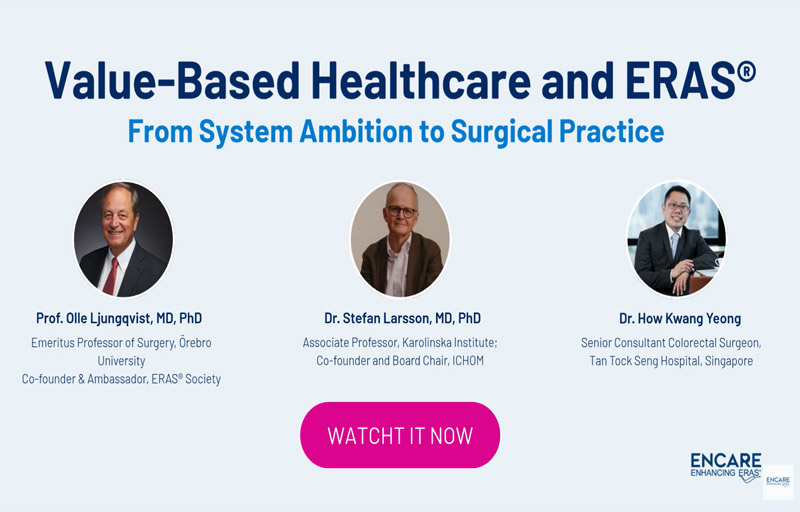
Webinar: Value-Based Healthcare and ERAS®: From System Ambition to Surgical Practice

Video subtitles available. Click Captions (cc) to select your preferred language. Please note that these subtitles are auto-generated, so minor errors may occur.

Value-based healthcare and Enhanced Recovery After Surgery (ERAS®) share one goal: better outcomes for patients at a sustainable cost. In this one-hour webinar, a co-founder of the ERAS® Society, a co-founder of ICHOM and a colorectal surgeon from Singapore discuss how the two approaches complement each other in daily surgical practice.

The session covers why process measures matter, which patient-reported outcomes ERAS® should add, how bundled payments can reward results, and why AI depends on standardized outcomes data. Several hundred participants from more than 58 countries registered.

Recorded: 8 October 2026 (live webinar)
Duration: 58 minutes
Language: English, with subtitles in Swedish, German, Spanish, French and Portuguese

Speakers

  • Professor Olle Ljungqvist
    Co-founder and Ambassador, ERAS® Society – presenter and panelist
  • Stefan Larsson
    Co-founder and Board Chair, ICHOM – International Consortium for Health Outcomes Measurement – presenter and panelist
  • Dr How Kwang Yeong
    Senior Consultant Colorectal Surgeon, Tan Tock Seng Hospital, Singapore – presenter and panel moderator
  • Rasmus Waller
    CEO, Encare – host

Chapters

  • 00:00 Welcome and introduction of the speakers
  • 01:46 Stefan Larsson: Measure what matters in healthcare
  • 07:49 ICHOM standard sets: 49 sets, 60% of the global disease burden
  • 09:10 Olle Ljungqvist: How ERAS® began
  • 13:37 Why surgical complications matter
  • 14:55 Guideline compliance in real hospitals and the ERAS® Interactive Audit System
  • 18:05 Dr How Kwang Yeong: ERAS® through Porter's value agenda
  • 21:42 A patient story: what happens after discharge
  • 25:39 Panel: Process measures vs outcome measures
  • 32:57 When clinicians and patients value different outcomes
  • 35:06 Cost, robotic surgery and new technology
  • 41:13 Bundled payments: the Stockholm hip and knee example
  • 44:47 Giving the care team ownership of the data
  • 46:11 AI, machine learning and outcomes data
  • 50:13 Reducing the measurement burden
  • 53:54 How ERAS® and ICHOM can work together
  • 56:50 Closing remarks

Related resources

Want to see how your hospital performs against the ERAS® guidelines? Get a demo of the ERAS® Interactive Audit System and team training. Book a demo
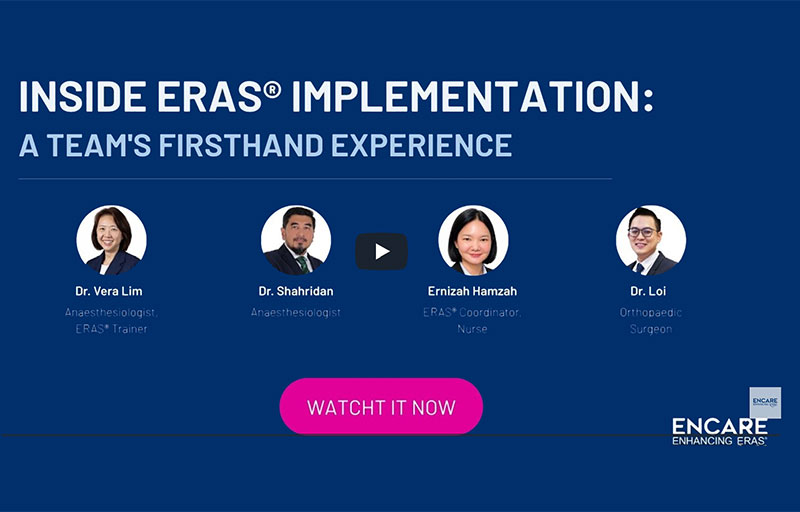
Webinar: Inside ERAS® Implementation

Video subtitles available. Click Captions (cc) to select your preferred language. Please note that these subtitles are auto-generated, so minor errors may occur.

In this 45-minute webinar, the ERAS® team from Gleneagles Hospital Johor in Malaysia and their ERAS® trainer, Dr Vera Lim from Tan Tock Seng Hospital in Singapore, share what it takes to bring ERAS® from guideline to daily practice. It is aimed at surgeons, anaesthesiologists, nurses, allied health professionals and hospital leaders who are planning or starting an ERAS® implementation. You will learn how the ERAS® Implementation Program is structured, how the team gained buy-in from clinicians and management, and how data and audit keep the pathway improving.

Dr Vera Lim describes the four seminars of the ERAS® Implementation Program: mapping the current pathway and baseline against the 20 or so recommendations in the ERAS® guidelines, co-designing a local pathway, testing it on one patient before launch, and measuring compliance and outcomes – a process that typically takes 8 to 12 months. Dr Shahridan Mohd Fathil explains why Gleneagles Hospital Johor started: the team was only delivering a small share of the elements rather than the 70–80% needed to make an impact, and he made the case to management around bed capacity and fewer complications. He also describes how informal conversations and documentation won over colleagues, and how the hospital became, in his words, the first in Malaysia certified in three surgical areas. Dr Loi Kai Weng describes the baseline before ERAS® – no standardised protocols and length of stay that varied between surgeons – and Ernizah Hamzah shows how nurses bring the pathway to the bedside by asking why a patient has not mobilised. The session closes with how audit data in the ERAS® Interactive Audit System (EIAS) is fed back to teams and used to assess ERAS® qualification, and with each speaker's advice for teams yet to start.

Recorded: 19 August 2026 (live webinar)
Duration: 45 minutes
Language: English (subtitles in English, French, German, Spanish, Portuguese and Swedish)

Speakers

  • Dr Vera Lim
    Senior Consultant, Anaesthesiology, Tan Tock Seng Hospital, Singapore – ERAS® trainer for the Gleneagles Hospital Johor implementation; explains the ERAS® Implementation Program, baseline measurement and the role of data.
  • Dr Shahridan Mohd Fathil
    Consultant Anaesthesiologist and ERAS® Lead & Advisor, Gleneagles Hospital Johor, Malaysia – describes why the hospital started ERAS®, how management approval was secured and how the team gained buy-in.
  • Siti Noor Ernizah Hamzah
    Staff Nurse and ERAS® Coordinator, Gleneagles Hospital Johor, Malaysia – describes the support from the trainers and the role of nurses and the ERAS® coordinator.
  • Dr Loi Kai Weng
    Consultant Orthopaedic Surgeon, Gleneagles Hospital Johor, Malaysia – lead surgeon for the arthroplasty pathway; describes the baseline before ERAS® and the multidisciplinary team.
  • Eva Reinander
    Encare, Asia-Pacific – co-host; discusses the growth of ERAS® across Asia-Pacific.
  • Charlotte & Eva
    Encare – host and moderator.

Chapters

  • 00:00 Welcome and introduction
  • 02:04 Introduction of the speakers
  • 05:19 Key stages of the ERAS® Implementation Program
  • 08:14 How long implementation takes
  • 09:45 Why Gleneagles Hospital Johor started with ERAS®
  • 12:15 Support from the ERAS® trainers
  • 14:15 Working with motivated teams
  • 15:52 Baseline practice and the biggest opportunities
  • 17:20 What an ERAS® baseline measures
  • 19:14 Common themes across Asian hospitals
  • 21:15 Why ERAS® is growing in Asia-Pacific
  • 23:36 Learning from visits to Tan Tock Seng Hospital
  • 25:35 Gaining buy-in from surgeons, nurses and leadership
  • 28:45 The role of the ERAS® nurse and coordinator
  • 33:02 The multidisciplinary ERAS® team
  • 35:02 Using data to drive change
  • 37:52 EIAS and ERAS® qualification
  • 38:56 Advice for teams about to start
  • 42:42 Closing remarks

Related resources

Want to see how EIAS can support ERAS® implementation and audit in your hospital? Book a demo

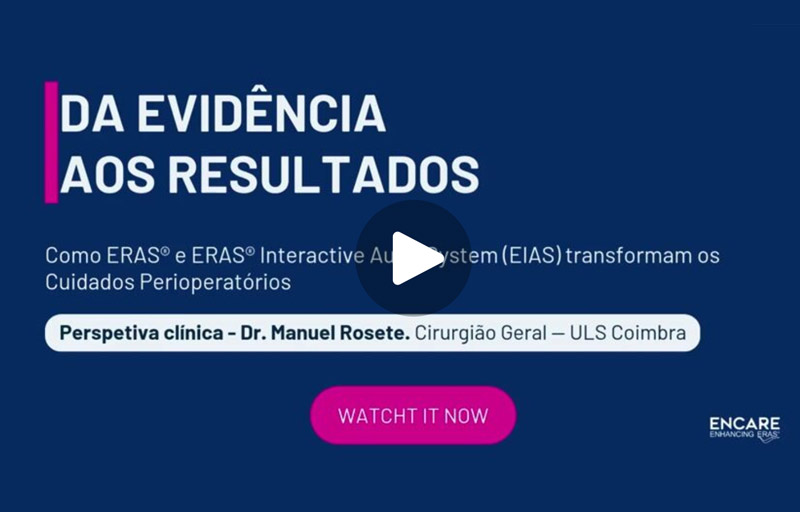
Webinar: From Evidence to Results: How ERAS® and the ERAS® Interactive Audit System (EIAS) Transform Perioperative Care

In this masterclass, held in Portuguese, Cláudia Santos Silva from Encare and Dr Manuel Rosete from the Coimbra University Hospitals in Portugal show how ERAS® and the ERAS® Interactive Audit System (EIAS) close the gap between the perioperative care teams believe they deliver and the care they actually deliver. It is aimed at surgeons, anaesthesiologists, nurses, allied health professionals and hospital managers in Portugal, Brazil and the rest of the Portuguese-speaking world. You will learn why protocol compliance drives surgical outcomes, how structured audit keeps compliance from slipping, and how one tertiary hospital grew ERAS® from a single colorectal protocol to 11 protocols and a dedicated ERAS® clinic.

Cláudia opens with a question for every clinician: what percentage of the care protocol was actually followed for your last surgical patient, measured rather than assumed? She outlines the scale of the problem – more than 313 million operations a year and one in five surgical patients with a postoperative complication – and presents recent evidence that ERAS® also works in Latin American hospitals. She explains the three principles of ERAS® (multidisciplinary, data-driven and evidence-based), the relationship between the ERAS® Society and Encare, and the multicentre study in Annals of Surgery showing that patients with more than 70% compliance have significantly fewer complications. After a demonstration of the ERAS® Interactive Audit System (EIAS), now also available in Portuguese, Dr Manuel Rosete describes the Coimbra experience: changing the mindset of clinicians and patients, training every professional along the pathway, dedicated nursing time, a multidisciplinary ERAS® consultation with six specialties in one morning, automated order sets, early discharge criteria based on clinical judgement and CRP, and an automated telephone follow-up after discharge. In his words, the median postoperative length of stay fell by 2 to 3 days, and the hospital has since moved from separate ERAS® consultations to a single interdisciplinary ERAS® clinic. The session ends with questions from the audience on first steps, the biggest challenges, data collection with SClínico and dedicated nursing and dietitian time.

Recorded: 13 May 2026 (live webinar)
Duration: 85 minutes
Language: Portuguese (subtitles in Portuguese, English, French, German, Spanish and Swedish)

Speakers

  • Cláudia Santos Silva
    Nurse, Encare – host and presenter; covers the problem of unmeasured compliance, the evidence behind ERAS®, the ERAS® Society and Encare, and the EIAS platform.
  • Dr Manuel Rosete
    General Surgeon, ULS Coimbra (Coimbra University Hospitals), Portugal, and Director of the ERAS® Clinic – describes how Coimbra implemented and expanded ERAS®, and answers questions from the audience.

Chapters

  • 00:00 Welcome and introduction
  • 00:20 How much of the protocol is actually followed?
  • 01:49 About the speaker
  • 03:22 Agenda
  • 04:34 The problem: variation in surgical care
  • 07:39 The iceberg: what hospitals don't measure
  • 08:34 ERAS® evidence from Latin America
  • 11:28 What ERAS® is
  • 12:27 Three principles: multidisciplinary, data-driven, evidence-based
  • 14:00 The ERAS® Society and Encare
  • 15:45 Measurable results of ERAS®
  • 17:03 Return on investment
  • 18:44 Why protocol compliance matters
  • 20:23 Poll: the biggest challenge in surgical quality
  • 21:36 Compliance and outcomes: the Annals of Surgery study
  • 23:32 Introducing EIAS
  • 24:06 EIAS video demonstration
  • 28:34 EIAS in Portuguese and what sets it apart
  • 33:29 ERAS® protocols and specialties
  • 33:48 Poll: your institution's current approach
  • 36:39 Introducing Dr Manuel Rosete
  • 37:20 ERAS® at Coimbra: aims and benefits
  • 39:21 The history of the Coimbra programme
  • 40:22 Challenge 1: changing mindsets
  • 46:32 Challenge 2: training healthcare professionals
  • 48:23 Challenge 3: human resources and dedicated time
  • 50:59 Challenge 4: the patient pathway and the ERAS® consultation
  • 53:19 Admission, order sets and automated care plans
  • 55:39 Minimally invasive surgery and benchmarking
  • 56:49 Early discharge criteria and CRP
  • 59:03 Results: length of stay in Coimbra
  • 59:59 Remote clinical follow-up after discharge
  • 1:03:00 Growth in surgical activity
  • 1:03:30 Auditing outcomes and complications with EIAS
  • 1:05:06 Benchmarking with other hospitals
  • 1:05:52 From one protocol to 11
  • 1:07:23 Growing pains: keeping teams motivated
  • 1:09:12 From ERAS® consultations to an ERAS® clinic
  • 1:10:52 Research, training centre and further expansion
  • 1:13:01 Invitation to the ERAS® Hands-On course
  • 1:14:26 Closing remarks
  • 1:17:06 Q&A: first steps for hospitals without structured measurement
  • 1:18:08 Q&A: the biggest challenge in Coimbra
  • 1:19:59 Q&A: data collection and integration with SClínico
  • 1:22:11 Q&A: dedicated nursing and dietitian time
  • 1:24:40 Close

Related resources

Want to see how EIAS can support ERAS® implementation and audit in your hospital? Book a demo

Video subtitles available. Click Captions (cc) to select your preferred language. Please note that these subtitles are auto-generated, so minor errors may occur.

A free masterclass with Claudia Santos Silva (Encare) and clinical panelist Dr. Manuel Rosete, General Surgeon — ULS Coimbra

313 million surgeries per year. Up to 20% with preventable complications. The evidence is there. But without consistent measurement, even the best protocols fall short.

In this masterclass, we explore how ERAS® — the gold standard in perioperative care — combined with the ERAS® Interactive Audit System (EIAS), the only digital audit platform validated by the ERAS® Society, gives hospital teams the tools to move from theory to practice.

The result? Perioperative care that is measurable, sustainable, and with real clinical and financial impact.

Clip: Do you think your hospital follows ERAS®? Think again.

𝐃𝐨 𝐲𝐨𝐮 𝐭𝐡𝐢𝐧𝐤 𝐲𝐨𝐮𝐫 𝐡𝐨𝐬𝐩𝐢𝐭𝐚𝐥 𝐟𝐨𝐥𝐥𝐨𝐰𝐬 𝐄𝐑𝐀𝐒®? 𝐓𝐡𝐢𝐧𝐤 𝐚𝐠𝐚𝐢𝐧.

Too often, what’s labeled “standard of care” falls short of ERAS® goals.

In this clip from a webinar hosted by SurgeOn – Surgery Unified, Professor Olle Ljungqvist demonstrates how even basic practices, such as IV antibiotics, vary significantly across hospitals.


That’s why structure, measurement, and real compliance matter.

The truth? 𝐓𝐡𝐞𝐫𝐞 𝐢𝐬 𝐧𝐨 𝐬𝐭𝐚𝐧𝐝𝐚𝐫𝐝 𝐨𝐟 𝐩𝐞𝐫𝐢𝐨𝐩𝐞𝐫𝐚𝐭𝐢𝐯𝐞 𝐜𝐚𝐫𝐞—𝐮𝐧𝐥𝐞𝐬𝐬 𝐲𝐨𝐮 𝐦𝐞𝐚𝐬𝐮𝐫𝐞 𝐢𝐭.

Clip: Which ERAS® element contributes the most?

Cherry-picking won’t cut it.

Prof. Olle Ljungqvist explains how the biggest gains in ERAS® come from protocol-wide compliance.

Raising adherence from 50% to 80%+ leads to major drops in complications and length of stay—because nearly every element contributes.

Watch this powerful excerpt from a webinar hosted by SurgeOn – Surgery Unified.
Then ask yourself: how compliant is your hospital?

💡 Not sure? The ERAS Flash Audit from Encare can help you find out.

Clip: You Say You Do ERAS®… But Can You Prove It?

Many clinicians say they’re doing ERAS®—but without data, it’s just a good intention.


Professor Olle Ljungqvist, co-founder ERAS® Society,  explains why true ERAS® requires structured audit of both outcomes and processes — not guesswork:

    • National data still shows lengths of stay far above ERAS® benchmarks.
    • The missing link? Audit and control.

That’s the difference between ERAS and ERAS®:
One is an idea or an ambition. The other is measurable, guideline-based, and transformational.

Video excerpt from a webinar hosted by SurgeOn – Surgery Unified,

Thank you!

Your email address has been successfully submitted.

We’ll be in touch soon with more information.

Add Your Heading Text Here