

Many hospitals begin their ERAS® journey with strong motivation and clinical engagement, yet struggle to achieve sustained improvement over time. A common misconception is that ERAS® implementation is primarily about adopting a protocol.
ERAS® implementations often fail when hospitals focus on protocols instead of structured implementation, measurement, and team-based change management.
In reality, ERAS® implementations often fail when there is a lack of lack structure, continuous measurement, and multidisciplinary ownership.
ERAS® success requires more than a protocol
Successful ERAS® implementation depends on choosing an implementation approach that matches a hospital’s current level of maturity, resources, and readiness for change. Without this alignment, teams risk fragmented adoption, variable compliance, and limited long-term impact.
A structured approach to getting ERAS® right
The ERAS® Implementation Pathways provide a clear, evidence-based roadmap for introducing ERAS® into clinical practice in a sustainable way. Developed in collaboration with the ERAS® Society and implemented globally by Encare, these pathways help hospitals move from intention to measurable results.
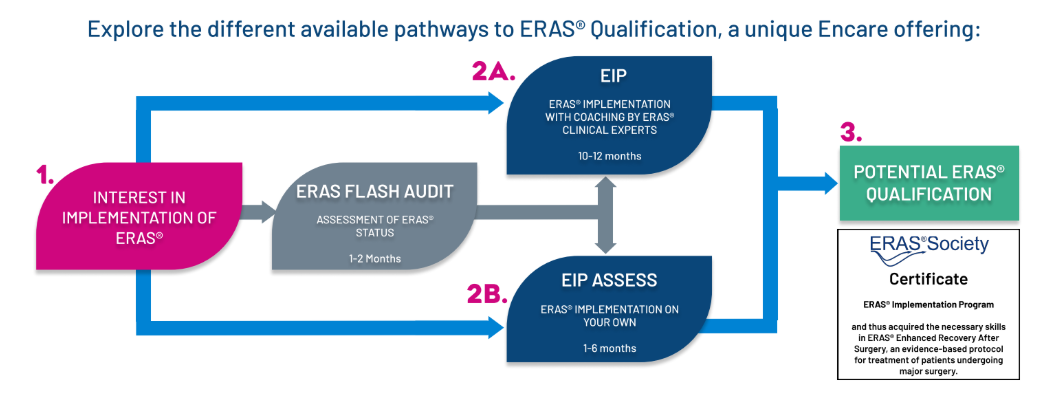
Hospitals can begin ERAS® implementation through several pathways, including:
- ERAS® Flash Audit, to assess current compliance and identify improvement potential
- ERAS® Implementation Program Assess, enabling self-led implementation with structured evaluation
- Fully guided ERAS® Implementation Program (EIP), with expert coaching and defined milestones
Core components that prevent implementation failure
All ERAS® Implementation Pathways are built on three essential elements:
- ERAS® Protocols based on international, evidence-based guidelines
- ERAS® Interactive Audit System (EIAS) for continuous measurement, benchmarking, and feedback
- A proven change-management methodology that enables multidisciplinary teams to translate data into sustained improvement
From implementation to sustained performance
Regardless of the entry point, these pathways are designed to help teams:
- Improve and maintain high compliance with ERAS® guidelines
- Reduce complications and variation in care
- Embed continuous improvement into everyday clinical practice
When ERAS® is implemented through a structured pathway, it becomes part of routine care rather than a time-limited initiative.