
Generic selectors
Exact matches only
Search in title
Search in content
Post Type Selectors
pages
post
Filter by Categories
All News
Case studies
News About Encare
Product updates
Publications
Upcoming events
Video & Webinars
ENHANCE ERAS® WITH ENCARE
Generic selectors
Exact matches only
Search in title
Search in content
Post Type Selectors
pages
post
Filter by Categories
All News
Case studies
News About Encare
Product updates
Publications
Upcoming events
Video & Webinars

Webinar: Value-Based Healthcare and ERAS®: From System Ambition to Surgical Practice

Video subtitles available. Click Captions (cc) to select your preferred language. Please note that these subtitles are auto-generated, so minor errors may occur.

Value-based healthcare and Enhanced Recovery After Surgery (ERAS®) share one goal: better outcomes for patients at a sustainable cost. In this one-hour webinar, a co-founder of the ERAS® Society, a co-founder of ICHOM and a colorectal surgeon from Singapore discuss how the two approaches complement each other in daily surgical practice.

The session covers why process measures matter, which patient-reported outcomes ERAS® should add, how bundled payments can reward results, and why AI depends on standardized outcomes data. Several hundred participants from more than 58 countries registered.

Recorded: 8 October 2026 (live webinar)
Duration: 58 minutes
Language: English, with subtitles in Swedish, German, Spanish, French and Portuguese

Speakers

  • Professor Olle Ljungqvist
    Co-founder and Ambassador, ERAS® Society – presenter and panelist
  • Stefan Larsson
    Co-founder and Board Chair, ICHOM – International Consortium for Health Outcomes Measurement – presenter and panelist
  • Dr How Kwang Yeong
    Senior Consultant Colorectal Surgeon, Tan Tock Seng Hospital, Singapore – presenter and panel moderator
  • Rasmus Waller
    CEO, Encare – host

Chapters

  • 00:00 Welcome and introduction of the speakers
  • 01:46 Stefan Larsson: Measure what matters in healthcare
  • 07:49 ICHOM standard sets: 49 sets, 60% of the global disease burden
  • 09:10 Olle Ljungqvist: How ERAS® began
  • 13:37 Why surgical complications matter
  • 14:55 Guideline compliance in real hospitals and the ERAS® Interactive Audit System
  • 18:05 Dr How Kwang Yeong: ERAS® through Porter's value agenda
  • 21:42 A patient story: what happens after discharge
  • 25:39 Panel: Process measures vs outcome measures
  • 32:57 When clinicians and patients value different outcomes
  • 35:06 Cost, robotic surgery and new technology
  • 41:13 Bundled payments: the Stockholm hip and knee example
  • 44:47 Giving the care team ownership of the data
  • 46:11 AI, machine learning and outcomes data
  • 50:13 Reducing the measurement burden
  • 53:54 How ERAS® and ICHOM can work together
  • 56:50 Closing remarks

Related resources

Want to see how your hospital performs against the ERAS® guidelines? Get a demo of the ERAS® Interactive Audit System and team training. Book a demo
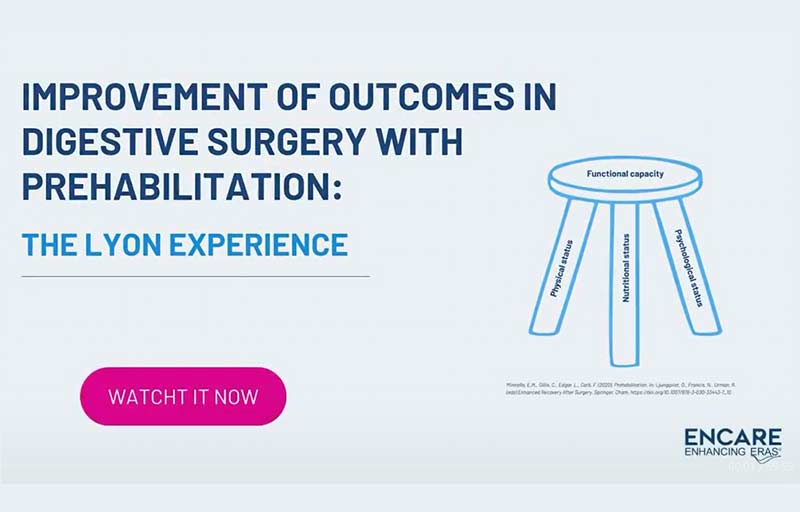
Webinar: Improvement of Outcomes in Digestive Surgery with Prehabilitation: The Lyon Experience

Video subtitles available. Click Captions (cc) to select your preferred language. Please note that these subtitles are auto-generated, so minor errors may occur.

In this one-hour webinar, a multidisciplinary team from Hospices Civils de Lyon (Édouard Herriot and Croix-Rousse hospitals) shows how they built and sustain a prehabilitation day hospital for patients undergoing major digestive surgery. It is aimed at surgeons, anaesthesiologists, ERAS® nurses, physiotherapists, dietitians and managers who want to add prehabilitation to an ERAS® pathway. You will learn how the day hospital is organised, how physical and nutritional preparation is delivered, and which factors decide whether a programme succeeds.

The session covers the prehabilitation day hospital model, where patients meet the prehabilitation nurse, anaesthesiologist, ERAS® nurse, physiotherapist and dietitian in one visit, followed by a weekly phone call. The physiotherapists present a three-week home programme built on respiratory physiotherapy, aerobic exercise and muscle strengthening, with results from 58 colorectal patients (an average of 18.5 days of preparation) and 22 pancreatic patients (15 days), where the 6-minute walk test improved by 22.5 m and 31.7 m respectively in patients under 70. The dietitian and nurse from Croix-Rousse explain nutritional prehabilitation in liver and pancreatic surgery, including malnutrition in cirrhosis and pancreatic insufficiency after resection. Dr Julie Périnel closes with the key factors for implementation – a dedicated multidisciplinary team, a coordinator, institutional support and compliance reporting through a prospective database and audit, as with the ERAS® Interactive Audit System (EIAS) – and the limitations the team still faces.

Recorded: 11 September 2026 (live webinar)
Duration: 60 minutes
Language: English (subtitles in English, French, German, Spanish, Portuguese and Swedish)

Speakers

  • Dr Julie Périnel
    Digestive and Pancreatic Surgeon, Hôpital Édouard Herriot, Hospices Civils de Lyon – clinical lead of the Prehabilitation Day Hospital; opens the session and presents implementation, key success factors and challenges.
  • Florence Abraham
    ERAS® Nurse Coordinator, Hôpital Édouard Herriot, Hospices Civils de Lyon – presents the prehabilitation day hospital model and the audit data.
  • Aina Moral-Alzaga
    Physiotherapist, Hôpital Édouard Herriot, Hospices Civils de Lyon – presents the physical prehabilitation programme (recorded).
  • Marta Gonzalez-Pereira
    Physiotherapist, Hôpital Édouard Herriot, Hospices Civils de Lyon – presents the physical prehabilitation programme (recorded).
  • Sarah Achatoui
    Dietitian, Hôpital de la Croix-Rousse, Hospices Civils de Lyon – presents nutritional prehabilitation in liver and pancreatic surgery (recorded).
  • Doriane Lionti
    ERAS® Nurse, Department of Digestive Surgery and Liver Transplantation, Hôpital de la Croix-Rousse, Hospices Civils de Lyon – presents nutritional prehabilitation in liver and pancreatic surgery (recorded).
  • Marie Meunier
    Encare – host and moderator.

Chapters

  • 00:00 Welcome and introduction
  • 02:37 Programme overview
  • 04:11 The prehabilitation day hospital model
  • 13:05 Data collection, audit and first results
  • 17:57 Physical prehabilitation: assessment and respiratory physiotherapy
  • 21:15 Aerobic training and muscle strengthening
  • 24:52 Results: functional capacity and body composition
  • 28:50 Nutritional prehabilitation in liver surgery
  • 37:58 Nutritional prehabilitation in pancreatic surgery
  • 44:56 Implementing and sustaining prehabilitation
  • 53:16 Limitations and challenges
  • 56:43 International survey and conclusions
  • 58:54 Closing remarks

Related resources

Want to see how EIAS can support prehabilitation and ERAS® audit in your hospital? Book a demo

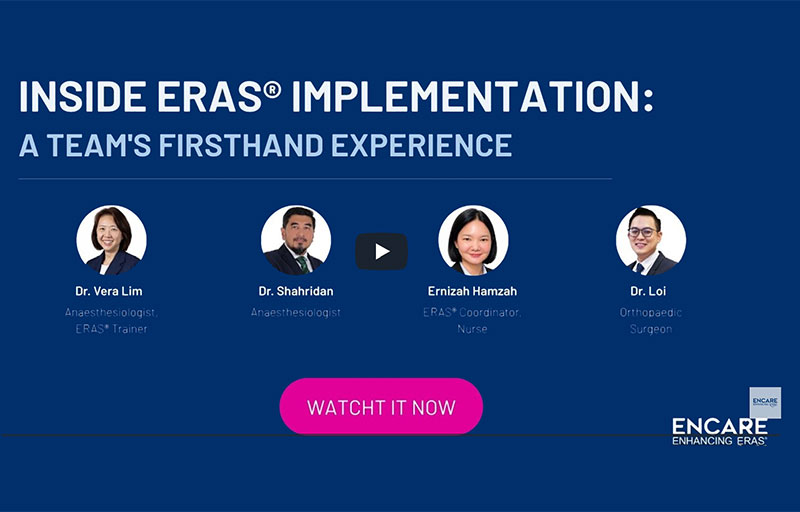
Webinar: Inside ERAS® Implementation

Video subtitles available. Click Captions (cc) to select your preferred language. Please note that these subtitles are auto-generated, so minor errors may occur.

In this 45-minute webinar, the ERAS® team from Gleneagles Hospital Johor in Malaysia and their ERAS® trainer, Dr Vera Lim from Tan Tock Seng Hospital in Singapore, share what it takes to bring ERAS® from guideline to daily practice. It is aimed at surgeons, anaesthesiologists, nurses, allied health professionals and hospital leaders who are planning or starting an ERAS® implementation. You will learn how the ERAS® Implementation Program is structured, how the team gained buy-in from clinicians and management, and how data and audit keep the pathway improving.

Dr Vera Lim describes the four seminars of the ERAS® Implementation Program: mapping the current pathway and baseline against the 20 or so recommendations in the ERAS® guidelines, co-designing a local pathway, testing it on one patient before launch, and measuring compliance and outcomes – a process that typically takes 8 to 12 months. Dr Shahridan Mohd Fathil explains why Gleneagles Hospital Johor started: the team was only delivering a small share of the elements rather than the 70–80% needed to make an impact, and he made the case to management around bed capacity and fewer complications. He also describes how informal conversations and documentation won over colleagues, and how the hospital became, in his words, the first in Malaysia certified in three surgical areas. Dr Loi Kai Weng describes the baseline before ERAS® – no standardised protocols and length of stay that varied between surgeons – and Ernizah Hamzah shows how nurses bring the pathway to the bedside by asking why a patient has not mobilised. The session closes with how audit data in the ERAS® Interactive Audit System (EIAS) is fed back to teams and used to assess ERAS® qualification, and with each speaker's advice for teams yet to start.

Recorded: 19 August 2026 (live webinar)
Duration: 45 minutes
Language: English (subtitles in English, French, German, Spanish, Portuguese and Swedish)

Speakers

  • Dr Vera Lim
    Senior Consultant, Anaesthesiology, Tan Tock Seng Hospital, Singapore – ERAS® trainer for the Gleneagles Hospital Johor implementation; explains the ERAS® Implementation Program, baseline measurement and the role of data.
  • Dr Shahridan Mohd Fathil
    Consultant Anaesthesiologist and ERAS® Lead & Advisor, Gleneagles Hospital Johor, Malaysia – describes why the hospital started ERAS®, how management approval was secured and how the team gained buy-in.
  • Siti Noor Ernizah Hamzah
    Staff Nurse and ERAS® Coordinator, Gleneagles Hospital Johor, Malaysia – describes the support from the trainers and the role of nurses and the ERAS® coordinator.
  • Dr Loi Kai Weng
    Consultant Orthopaedic Surgeon, Gleneagles Hospital Johor, Malaysia – lead surgeon for the arthroplasty pathway; describes the baseline before ERAS® and the multidisciplinary team.
  • Eva Reinander
    Encare, Asia-Pacific – co-host; discusses the growth of ERAS® across Asia-Pacific.
  • Charlotte & Eva
    Encare – host and moderator.

Chapters

  • 00:00 Welcome and introduction
  • 02:04 Introduction of the speakers
  • 05:19 Key stages of the ERAS® Implementation Program
  • 08:14 How long implementation takes
  • 09:45 Why Gleneagles Hospital Johor started with ERAS®
  • 12:15 Support from the ERAS® trainers
  • 14:15 Working with motivated teams
  • 15:52 Baseline practice and the biggest opportunities
  • 17:20 What an ERAS® baseline measures
  • 19:14 Common themes across Asian hospitals
  • 21:15 Why ERAS® is growing in Asia-Pacific
  • 23:36 Learning from visits to Tan Tock Seng Hospital
  • 25:35 Gaining buy-in from surgeons, nurses and leadership
  • 28:45 The role of the ERAS® nurse and coordinator
  • 33:02 The multidisciplinary ERAS® team
  • 35:02 Using data to drive change
  • 37:52 EIAS and ERAS® qualification
  • 38:56 Advice for teams about to start
  • 42:42 Closing remarks

Related resources

Want to see how EIAS can support ERAS® implementation and audit in your hospital? Book a demo

Webinar: From Evidence to Results: How ERAS® and the ERAS® Interactive Audit System (EIAS) Transform Perioperative Care

In this masterclass, held in Portuguese, Cláudia Santos Silva from Encare and Dr Manuel Rosete from the Coimbra University Hospitals in Portugal show how ERAS® and the ERAS® Interactive Audit System (EIAS) close the gap between the perioperative care teams believe they deliver and the care they actually deliver. It is aimed at surgeons, anaesthesiologists, nurses, allied health professionals and hospital managers in Portugal, Brazil and the rest of the Portuguese-speaking world. You will learn why protocol compliance drives surgical outcomes, how structured audit keeps compliance from slipping, and how one tertiary hospital grew ERAS® from a single colorectal protocol to 11 protocols and a dedicated ERAS® clinic.

Cláudia opens with a question for every clinician: what percentage of the care protocol was actually followed for your last surgical patient, measured rather than assumed? She outlines the scale of the problem – more than 313 million operations a year and one in five surgical patients with a postoperative complication – and presents recent evidence that ERAS® also works in Latin American hospitals. She explains the three principles of ERAS® (multidisciplinary, data-driven and evidence-based), the relationship between the ERAS® Society and Encare, and the multicentre study in Annals of Surgery showing that patients with more than 70% compliance have significantly fewer complications. After a demonstration of the ERAS® Interactive Audit System (EIAS), now also available in Portuguese, Dr Manuel Rosete describes the Coimbra experience: changing the mindset of clinicians and patients, training every professional along the pathway, dedicated nursing time, a multidisciplinary ERAS® consultation with six specialties in one morning, automated order sets, early discharge criteria based on clinical judgement and CRP, and an automated telephone follow-up after discharge. In his words, the median postoperative length of stay fell by 2 to 3 days, and the hospital has since moved from separate ERAS® consultations to a single interdisciplinary ERAS® clinic. The session ends with questions from the audience on first steps, the biggest challenges, data collection with SClínico and dedicated nursing and dietitian time.

Recorded: 13 May 2026 (live webinar)
Duration: 85 minutes
Language: Portuguese (subtitles in Portuguese, English, French, German, Spanish and Swedish)

Speakers

  • Cláudia Santos Silva
    Nurse, Encare – host and presenter; covers the problem of unmeasured compliance, the evidence behind ERAS®, the ERAS® Society and Encare, and the EIAS platform.
  • Dr Manuel Rosete
    General Surgeon, ULS Coimbra (Coimbra University Hospitals), Portugal, and Director of the ERAS® Clinic – describes how Coimbra implemented and expanded ERAS®, and answers questions from the audience.

Chapters

  • 00:00 Welcome and introduction
  • 00:20 How much of the protocol is actually followed?
  • 01:49 About the speaker
  • 03:22 Agenda
  • 04:34 The problem: variation in surgical care
  • 07:39 The iceberg: what hospitals don't measure
  • 08:34 ERAS® evidence from Latin America
  • 11:28 What ERAS® is
  • 12:27 Three principles: multidisciplinary, data-driven, evidence-based
  • 14:00 The ERAS® Society and Encare
  • 15:45 Measurable results of ERAS®
  • 17:03 Return on investment
  • 18:44 Why protocol compliance matters
  • 20:23 Poll: the biggest challenge in surgical quality
  • 21:36 Compliance and outcomes: the Annals of Surgery study
  • 23:32 Introducing EIAS
  • 24:06 EIAS video demonstration
  • 28:34 EIAS in Portuguese and what sets it apart
  • 33:29 ERAS® protocols and specialties
  • 33:48 Poll: your institution's current approach
  • 36:39 Introducing Dr Manuel Rosete
  • 37:20 ERAS® at Coimbra: aims and benefits
  • 39:21 The history of the Coimbra programme
  • 40:22 Challenge 1: changing mindsets
  • 46:32 Challenge 2: training healthcare professionals
  • 48:23 Challenge 3: human resources and dedicated time
  • 50:59 Challenge 4: the patient pathway and the ERAS® consultation
  • 53:19 Admission, order sets and automated care plans
  • 55:39 Minimally invasive surgery and benchmarking
  • 56:49 Early discharge criteria and CRP
  • 59:03 Results: length of stay in Coimbra
  • 59:59 Remote clinical follow-up after discharge
  • 1:03:00 Growth in surgical activity
  • 1:03:30 Auditing outcomes and complications with EIAS
  • 1:05:06 Benchmarking with other hospitals
  • 1:05:52 From one protocol to 11
  • 1:07:23 Growing pains: keeping teams motivated
  • 1:09:12 From ERAS® consultations to an ERAS® clinic
  • 1:10:52 Research, training centre and further expansion
  • 1:13:01 Invitation to the ERAS® Hands-On course
  • 1:14:26 Closing remarks
  • 1:17:06 Q&A: first steps for hospitals without structured measurement
  • 1:18:08 Q&A: the biggest challenge in Coimbra
  • 1:19:59 Q&A: data collection and integration with SClínico
  • 1:22:11 Q&A: dedicated nursing and dietitian time
  • 1:24:40 Close

Related resources

Want to see how EIAS can support ERAS® implementation and audit in your hospital? Book a demo

Video subtitles available. Click Captions (cc) to select your preferred language. Please note that these subtitles are auto-generated, so minor errors may occur.

A free masterclass with Claudia Santos Silva (Encare) and clinical panelist Dr. Manuel Rosete, General Surgeon — ULS Coimbra

313 million surgeries per year. Up to 20% with preventable complications. The evidence is there. But without consistent measurement, even the best protocols fall short.

In this masterclass, we explore how ERAS® — the gold standard in perioperative care — combined with the ERAS® Interactive Audit System (EIAS), the only digital audit platform validated by the ERAS® Society, gives hospital teams the tools to move from theory to practice.

The result? Perioperative care that is measurable, sustainable, and with real clinical and financial impact.

Webinar – ERAS® Implementation in Gynecology (German webinar with subtitles available)

Video subtitles available. Click Settings to select your preferred language. Please note that these subtitles are auto-generated, so minor errors may occur.

In this German-language webinar, the ERAS® teams from Charité – Universitätsmedizin Berlin and the University Medical Center Hamburg-Eppendorf (UKE) share how they have implemented ERAS® in gynecology and gynecologic oncology. It is aimed at gynecologic surgeons, anesthesiologists, nurses and hospital teams who are starting or developing an ERAS® program. You will learn why ERAS® is about strengthening the patient's health rather than only avoiding complications, how frailty assessment and prehabilitation fit into the pathway, and what the ERAS® nurse does before and after surgery.

Prof. Jalid Sehouli opens with the patient journey: why functional status matters more than chronological age, why sarcopenia, quality of life and polypharmacy should be assessed before surgery, and why de-escalation – no classic bowel preparation, no unnecessary drains, shorter fasting with carbohydrate loading up to two hours before surgery – is as important as adding new measures. Prof. Barbara Schmalfeldt describes how the UKE started its program in 2018 with one entity, ovarian cancer, how the interprofessional team and the ERAS® nurse are organized, and how regular audits improved compliance, reduced fluid administration and shortened length of stay. Dr Susanne Reuter then follows a 60-year-old patient with suspected ovarian cancer through the UKE ERAS® pathway – from patient information, brochures and the patient diary to intraoperative and postoperative compliance in the audit – and describes how the 24-hour monitoring unit (PAKO24) was introduced for patients after multivisceral surgery. Dr Lee from the Charité presents the KORE-INNOVATION project, which combined ERAS® with personalized trimodal prehabilitation based on a comprehensive frailty assessment, including early feedback from patients. Two ERAS® nurses close the presentations: Henriette Thorau on preoperative assessment and education, and Freya Brodersen on postoperative ERAS® nurse rounds, the 30-day telephone follow-up and process evaluation with the ERAS® Interactive Audit System (EIAS). The discussion covers the contribution of nursing, compliance items that are hard to implement – drains, patient blood management and long-acting opioids – and how to keep the program alive when staff change.

Recorded: 29 August 2025 (live webinar)
Duration: 1 hour 53 minutes
Language: German (subtitles in German, English, French, Spanish, Portuguese and Swedish)

Speakers

  • Prof. Dr. Jalid Sehouli
    Director, Department of Gynecology with Center for Oncological Surgery, Charité – Universitätsmedizin Berlin – leads the Charité ERAS® team; gives the introduction on ERAS® in gynecology and comments in the discussion.
  • Prof. Dr. Barbara Schmalfeldt
    Director, Department of Gynecology, University Medical Center Hamburg-Eppendorf (UKE) – leads the UKE ERAS® team; presents the implementation of ERAS® at the UKE.
  • Dr Susanne Reuter
    Department of Gynecology, University Medical Center Hamburg-Eppendorf (UKE) – presents a clinical case through the UKE ERAS® pathway and the evaluation of the PAKO24 monitoring unit, and answers questions on compliance.
  • Dr [PLATSHÅLLARE – förnamn] Lee
    [PLATSHÅLLARE – titel], Department of Gynecology with Center for Oncological Surgery, Charité – Universitätsmedizin Berlin – presents prehabilitation in the context of ERAS® and the KORE-INNOVATION project.
  • Henriette Thorau
    ERAS® Nurse, [PLATSHÅLLARE – sjukhus/avdelning] – presents the role of the ERAS® nurse and preoperative care.
  • Freya Brodersen
    ERAS® Nurse and Advanced Practice Nurse (M.Sc.), University Medical Center Hamburg-Eppendorf (UKE) – presents postoperative ERAS® nurse care, telephone follow-up and process evaluation.
  • Annabelle Burkhardt
    Customer Development Manager, Encare – host and moderator.

Chapters

  • 00:00 Welcome and introduction
  • 02:45 ERAS® in gynecology: the patient journey (Prof. Jalid Sehouli)
  • 07:45 What affects recovery and drives complications
  • 12:17 Age, frailty, sarcopenia and polypharmacy
  • 17:19 De-escalation: leaving out what is not needed
  • 19:17 Fasting, carbohydrate loading and walking into the operating room
  • 21:23 Fluid management and bowel preparation
  • 25:40 Prehabilitation and three groups of frailty
  • 28:16 What disrupts an ERAS® pathway
  • 32:44 Implementing ERAS® at the UKE (Prof. Barbara Schmalfeldt)
  • 39:00 The UKE ERAS® team and patient pathway
  • 43:32 Implementation phase, training and audit
  • 47:17 Results: compliance, fluids and length of stay
  • 50:52 Clinical case presentation (Dr Susanne Reuter)
  • 54:04 The patient: suspected ovarian cancer
  • 57:13 Patient information and brochures
  • 59:49 ERAS® in daily practice: SOP and flowcharts
  • 1:01:18 Surgery and intraoperative compliance
  • 1:04:28 Postoperative course and outcome
  • 1:06:56 Evaluation and the PAKO24 monitoring unit
  • 1:10:28 Prehabilitation in the context of ERAS® (Dr Lee, Charité)
  • 1:15:34 KORE-INNOVATION: frailty assessment and personalized prehabilitation
  • 1:18:30 What patients say about prehabilitation
  • 1:23:32 The role of the ERAS® nurse (Henriette Thorau)
  • 1:29:26 The preoperative pathway with the ERAS® nurse
  • 1:32:46 Postoperative care and ERAS® nurse rounds (Freya Brodersen)
  • 1:37:59 30-day telephone follow-up
  • 1:39:27 Process evaluation with EIAS
  • 1:41:07 Discussion: the contribution of nursing
  • 1:45:53 Discussion: drains, patient blood management and opioids
  • 1:50:06 Discussion: training and staff turnover
  • 1:52:04 Closing remarks

Related resources

Want to see how EIAS can support ERAS® implementation and audit in your gynecology department? Book a demo

In our webinar (held in German, with subtitles available in multiple languages), you will learn how ERAS® can be successfully implemented in gynecologic surgery. Using concrete case examples, experienced experts from the DACH region will provide practical insights into how clinical workflows can be systematically optimized while at the same time sustainably improving patient recovery.

Webinar – Implementing ERAS® in Hip & Knee Arthroplasty

Video subtitles available. Click Settings to select your preferred language. Please note that these subtitles are auto-generated, so minor errors may occur.

In this 69-minute webinar, anaesthesiologist Dr Thomas Boogmans and pharmacist and clinical biologist Laura Bogaert from AZ Rivierenland in Belgium show how ERAS® can be successfully implemented in hip and knee arthroplasty. It is aimed at orthopaedic surgeons, anaesthesiologists, nurses, physiotherapists, quality managers and hospital leaders who are starting or improving an ERAS® pathway in orthopaedics. You will learn which care elements matter most, how AZ Rivierenland translated the ERAS® guidelines into a local protocol, and how change management turns a protocol into daily practice.

Dr Boogmans opens with the hospital's own results, monitored in the ERAS® Interactive Audit System (EIAS): a mean length of stay of 1.7 days after hip arthroplasty and 1.8 days after knee arthroplasty, and a complication rate of around 8–10% that deliberately includes postoperative pain. He then moves from Henrik Kehlet's 1997 paper to the ERAS® Society guideline for hip and knee arthroplasty published by Thomas Wainwright in 2020, with its 17 recommendations. His key message is that there is no consensus on which elements matter most, but that a core set – multimodal opioid-sparing analgesia, timely tranexamic acid and early mobilisation – appears consistently, and that higher compliance with a local protocol leads to better outcomes, as shown in the POWER2 study. He walks through the protocol at AZ Rivierenland: joint classes and an ERAS® nurse for patient education, diabetes screening, prehabilitation and nutrition, carbohydrate loading, patient blood management (up to 25% of patients are anaemic before surgery), surgery without a tourniquet, high-dose corticosteroids, intravenous tranexamic acid, mobilisation within 24 hours and nurse-led discharge criteria. Laura Bogaert then explains why ERAS® adoption varies so widely and how to lead the change: the individual change curve, adopter categories, Kotter's eight-step model, quick wins and monitoring. The session closes with the hospital's timeline from a kick-off email in 2018, via an Excel file and a free online database, to the ERAS® Implementation Program, EIAS and ERAS® Qualification in September 2023, followed by ten commandments for implementation and a Q&A on iron therapy, patient blood management, the ERAS® nurse, 90-day complications and how long to monitor a pathway.

Recorded: 4 September 2025 (live webinar)
Duration: 69 minutes
Language: English (subtitles in English, French, German, Spanish, Portuguese and Swedish)

Speakers

  • Dr Thomas Boogmans
    Anaesthesiologist and Medical Head of the Surgical Day Hospital (campus Bornem), AZ Rivierenland, Belgium – presents the ERAS® principles in hip and knee arthroplasty, the hospital's protocol and its implementation journey.
  • Laura Bogaert
    Pharmacist and Clinical Biologist, Laboratory of Clinical Biology, AZ Rivierenland, Belgium – presents the practical implementation of ERAS® and change management.
  • Charlotte Zwart
    Customer Success Manager, Encare – host and moderator.

Chapters

  • 00:00 Welcome and introduction
  • 01:32 Opening and audience poll
  • 03:01 Goals of the session
  • 03:41 Results at AZ Rivierenland
  • 05:55 What is ERAS® to you?
  • 07:12 The theory: from Kehlet to the ERAS® Society guideline
  • 10:27 What you need to know: core elements and compliance
  • 13:19 The local protocol and preoperative patient education
  • 14:57 Optimisation of chronic disease
  • 16:17 Prehabilitation, nutrition and carbohydrate loading
  • 19:33 Patient blood management
  • 21:15 Intraoperative care: surgical approach and anaesthesia
  • 23:35 Multimodal opioid-sparing analgesia
  • 25:20 Fluid therapy and high-dose corticosteroids
  • 27:16 Tranexamic acid, normothermia and PONV prophylaxis
  • 28:21 Early mobilisation and discharge criteria
  • 30:23 Thromboprophylaxis
  • 31:53 ERAS® adoption rates worldwide
  • 34:11 Change as an emotional journey and adopter categories
  • 36:41 Quality improvement and change management frameworks
  • 38:21 Kotter's eight-step change model
  • 41:08 Removing obstacles to change
  • 43:47 Quick wins, sustaining and embedding the change
  • 46:08 The implementation timeline at AZ Rivierenland
  • 48:38 Take-home messages
  • 49:21 Ten commandments for ERAS® implementation
  • 52:53 Q&A: the geriatrician in the ERAS® team
  • 54:10 Q&A: treating preoperative anaemia with iron
  • 57:16 Q&A: getting surgeons to use patient blood management
  • 1:00:08 Q&A: the role of the ERAS® nurse
  • 1:01:24 Q&A: in-hospital and 90-day complications
  • 1:02:12 Q&A: removing barriers to preoperative optimisation
  • 1:07:01 Q&A: how long to monitor an ERAS® pathway
  • 1:08:45 Closing remarks

Related resources

Want to see how EIAS can support ERAS® implementation and audit in hip and knee arthroplasty at your hospital? Book a demo

Thank you!

Your email address has been successfully submitted.

We’ll be in touch soon with more information.

Add Your Heading Text Here