
Innovations in Pediatric Surgical Quality® | 1-2 December2025 | Cleveland, Ohio, USA
Author: admin
ERAS Nurse- DACH Treffen
(Congress) ERAS Nurse- DACH Treffen | 22 November 2025 | Munich, Germany
ERAS® World Congress
(Congress) ERAS® World Congress | 17-19 September 2025 | Turin, Italy
Viszeralmedizin 2025
(Congress) Viszeralmedizin 2025 | 15-20 september 2025 | Online
Implementing ERAS® in Hip & Knee Arthroplasty
(Webinar) Implementing ERAS® in Hip & Knee Arthroplasty | 4 September 2025 | Online | Register here
ERAS® Implementierung in der Gynäkologie
(Webinar) ERAS® Implementierung in der Gynäkologie | 29 August 2025 | Online | Register here
Prehabilitation Module
Empower better outcomes by standardizing prehab, improving care, and driving research.
Support the Future of Prehabilitation
Prehabilitation is an evolving area of perioperative care with promising potential—but evidence is still emerging. The ERAS® Interactive Audit System (EIAS) Prehabilitation Module helps your team lead the way by:
- Standardizing care across patient pathway
- Embedding prehabilitation directly into clinical workflow
- Collecting high-quality, structured data for personalized care and research
- Supporting future guidelines through real-world evidence
📄 Download the Prehabilitation Module One-Pager:
Watch the 3-Minute Introduction to the EIAS Prehabilitation Module
Why Integrate Prehabilitation in the Surgical Pathway?
- 1 in 3 surgical patients face preoperative vulnerability (frailty, malnutrition, anxiety ̧
- Studies show a positive impact with improved recovery, fewer complications, and reduced hospital stay.
- Endorsed in Enhanced Recovery After Surgery (ERAS) and major surgical fields.
Key Benefits for Your Clinical Teams
Coordinated, Multidisciplinary Care
- Supports collaboration across physicians, nurses, physiotherapists, dietitians, and psychologists
- Unified patient data accessible to all care team members within the EIAS ecosystem
Time-Saving and Data-Driven
- Structured data collection for consistent reporting
- All prehabilitation data in one place as well as patient outcomes
- Ready-to-use elements for building a structured evidence base
Comprehensive, Structured Data Collection
Organized into four structured sections for complete visibility:
- General: Foundational investigations to enable implementation of the three clinical components of prehabilitation.
- Nutrition: Screening, interventions, nutritional intake tracking
- Physical Conditioning: Assessments, activity plans, exercise logs
- Psychological Management: Anxiety assessment and control plan
Track the full prehabilitation journey, from eligibility and planning to execution and recovery, to evaluate what works best for which patients.
Prehabilitation may be a strategic intervention that utilizes the waiting period before surgery to optimize the physical, metabolic, and mental condition of high-risk cancer patients.
Drive Personalized & Population-Level Improvement
- Follow patient cohorts and compare outcomes across time
- Identify trends and fine-tune protocols for maximum clinical impact
- Contribute to multicenter research and emerging prehabilitation guidelines
Ready to bring the Prehabilitation Module into your EIAS? Speak with us today to get started.
FAQ
What exactly is the Prehabilitation Module?
The Prehabilitation Module in EIAS is a structured add-on designed to collect standardized data on preoperative optimization of patients.
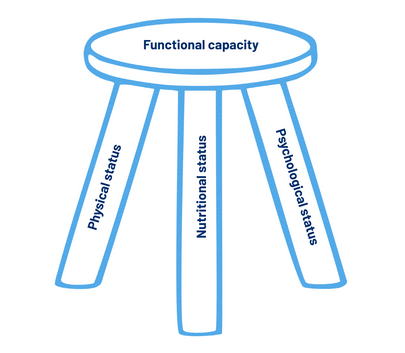
In addition to the base protocol, it covers three main domains: physical, nutritional, and psychological, helping teams document and analyze how prehabilitation interventions impact recovery.
What challenge does the Prehabilitation Module solve?
Prehabilitation is a growing area in perioperative care, but evidence across studies remains moderate to low due to a lack of standardization.
By integrating prehabilitation directly into EIAS, the module provides a consistent data collection structure that supports care standardization, research, and guideline improvement.
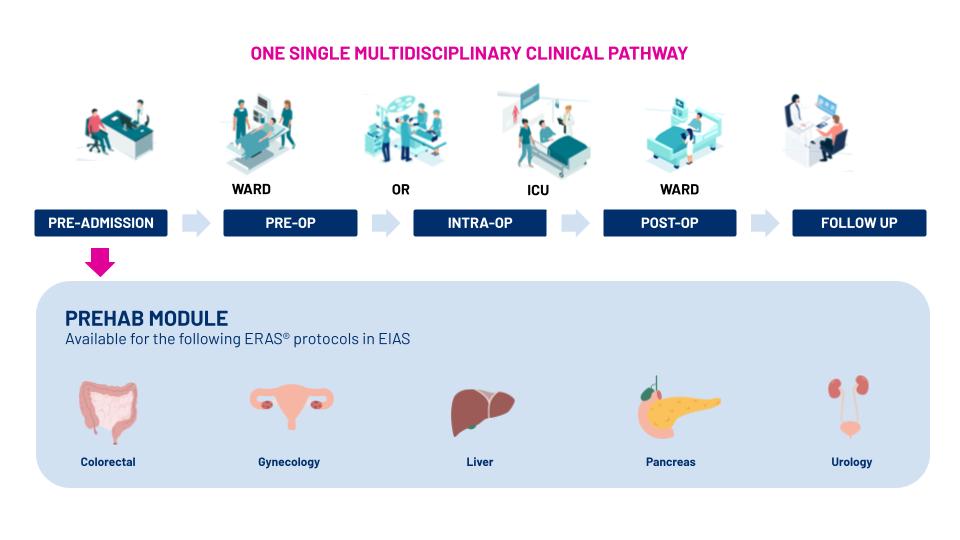
For which ERAS® protocols is the Prehabilitation Module available?
Colorectal
Gynecology
Urology
Pancreas
Liver
How is the Prehabilitation Module organized?
It is structured into four main sections for complete visibility of the prehabilitation journey:
- General Prehabilitation – Baseline data and investigations
- Nutrition Prehabilitation – Screening, interventions, and intake tracking
- Physical Prehabilitation – Assessments, exercise plans, and activity logs
- Psychological Prehabilitation – Anxiety assessment and control plan
Each section is supported by detailed help texts and auto-calculated parameters to facilitate understanding and consistency.
Does the module affect existing compliance items?
No. The Prehabilitation Module introduces no additional compliance items.
It is designed for structured data collection and analysis without altering existing compliance metrics.
Can we analyze or export the data collected in the module?
Yes. Data from the Prehabilitation Module can be filtered directly in the Analysis section and exported for further customized analysis.
Have another question about the Prehabilitation Module? We’d love to hear from you, reach us at [email protected]
Precision ERAS® – Your Roadmap to Next-Gen Care
Discover the potential of simulating outcomes before you change them.
Precision ERAS® is an innovative concept that uses hospital data to explore how targeted compliance improvements might influence outcomes.
Prioritize the right elements, reduce complications, and support smarter continuous improvement discussions.
Meet Precision ERAS®
Precision ERAS® is being developed as the next evolution of the ERAS® Interactive Audit System (EIAS).
It is designed to model the potential effect of improved ERAS® guideline adherence on patient outcomes—before changing local processes.
What it aims to deliver:
- Simulate how changes in compliance might affect outcomes.
- Identify which ERAS® elements could reduce readmissions, LOS, or complications.
- Support more informed discussions and reduce guesswork in continuous improvement strategy.
Built for Real Clinical Decisions – Concept Scenarios
Use Case 1 – Nurse Team
Use Case 2 – Surgeon Team
Use Case 3 – Researcher
“It helps us see where to focus our efforts to improve outcomes rather than just compliance.” – Beta Customer User
Be Part of What’s Next
Precision ERAS® is under development and external validation.
Do you want to be among the first to see what’s next?
Register for our newsletter to stay updated. Subscribe to Updates
Explore ERAS® Chatbot – Your 24/7 Clinical Companion
ERAS® Colorectal Surgery Guidelines 2025 – Key Updates
The ERAS® Society has released the long-awaited 2025 colorectal surgery guidelines, reflecting the latest evidence and global best practices. These updates refine perioperative care across preoperative, intraoperative, and postoperative phases — adding precision, introducing new recommendations, and adjusting prior guidance where evidence has evolved.
At Encare, we are proud to be the only company working directly with the ERAS® Society and the guideline authors to bring the 2025 colorectal surgery updates into the ERAS® Interactive Audit System (EIAS). This means that EIAS is the only platform globally where hospitals can access, apply, and measure adherence to the most up-to-date ERAS® standards — with full confidence that the content is accurate, validated, and aligned with the experts who wrote the guidelines.
Below is a breakdown of the key changes clinicians should be aware of.
Preoperative
- Risk & Comorbidity
- Use validated screening tools for high-risk patients.
- Clearer guidance on optimizing comorbidities.
- Anemia: routine screening; IV iron + EPO now included.
- Lifestyle
- Alcohol cessation: downgraded (weak).
- Smoking cessation: unchanged, strongly recommended.
- Prehabilitation: no specific regimen recommended.
- Nutrition
- Routine screening mandatory; immunonutrition added for malnourished.
- Other
- PONV prophylaxis: expanded optimal regimens.
- Thromboprophylaxis: intraop IPC + more liberal pharmacologic timing.
- Bowel prep: MBP alone discouraged (weaker); oral antibiotics emphasized.
- Carb loading: downgraded (weak, no clinical benefit).
Intraoperative
- Normothermia: methods clarified, strong support remains.
- Fluids: shift from “near-zero” to slightly positive balance.
- Surgery: MIS = standard of care.
- Drainage: still not routine; weaker evidence for rectal resections.
Postoperative
- Tubes/Monitoring
- NGT: not recommended post-op (evidence downgraded).
- Glucose control: HbA1c + specific post-op targets included.
- Fluids: maintain slightly positive balance (≤2.5 kg weight gain).
- Urinary catheter: remove ≤24h (colonic MIS), ≤48h (rectal MIS).
- Ileus: multimodal prevention; chewing gum reintroduced.
- Analgesia: multimodal (acetaminophen, NSAIDs, TAP blocks, intrathecal morphine); epidural alternatives for open surgery now accepted.
- Nutrition: early oral feeding + supplements; immunonutrition supported.
- Mobilization: ≥3 hrs/day from POD1 to discharge.
Highlights & Take-Homes
- Precision & detail added: predictive tools, comorbidity optimization, glucose, anemia.
- Lifestyle advice weakened: alcohol cessation, carb loading, Mechanical Bowel Preparation (MBP) avoidance.
- Practice shifts: MIS as standard, fluids slightly positive, catheter timing specified.
- Recovery focus: early feeding, structured mobilization, multimodal ileus & pain prevention.
Reference
Gustafsson, U. O., Rockall, T. A., Wexner, S., How, K. Y., Emile, S., Marchuk, A., Fawcett, W. J., Sioson, M., Riedel, B., Chahal, R., Balfour, A., Baldini, G., de Groof, E. J., Romagnoli, S., Coca-Martinez, M., Grass, F., Brindle, M., & Hubner, M. (2025). Guidelines for perioperative care in elective colorectal surgery: Enhanced Recovery After Surgery (ERAS) Society recommendations 2025. Surgery, 184, Article 109397. https://doi.org/10.1016/j.surg.2025.109397
With these updates, the ERAS® Society underscores the ongoing evolution of enhanced recovery, aiming for safer surgery and faster recovery worldwide. Integrated into EIAS, these guidelines become immediately actionable, helping teams measure, compare, and continuously improve patient outcomes.
Learn more about how your hospital can apply the 2025 colorectal protocol in EIAS: Speak with Encare
EIAS in Your Language
We are excited to share that the ERAS® Interactive Audit System (EIAS) will soon be made available in multiple languages.
Today, many hospitals try to rely on browser-based translation tools, such as Google Translate, to navigate EIAS. However, these tools do not work properly across the platform—some parts remain untranslated, while others break the interface or even cause crashes. This makes them unreliable for clinical use and creates unnecessary risks and barriers for healthcare teams. In addition, these web-based translation tools often produce inconsistent or poor-quality translations, which can lead to misunderstandings in clinical workflows.
This update is part of our commitment to make EIAS more accessible to healthcare teams worldwide. By bringing the platform into your local language, we make it easier for hospitals and clinicians to work with ERAS® guidelines in their daily practice, without language barriers.
Image: Preview of EIAS in Portuguese interface. The Radar chart visually illustrates ERAS® compliance, providing a clear overview of adherence both across care phases and within individual compliance items. This allows you to quickly identify strengths and areas for improvement in protocol implementation.
Image: Preview of EIAS in Portuguese interface. The Dashboard page provides a clear overview of your ERAS® performance. It highlights key measures such as length of stay, complication rates, and overall ERAS® compliance. In addition, it tracks critical outcomes including readmissions, reoperations, and mortality, giving you a comprehensive picture of patient care and program effectiveness.
Stay tuned as we continue expanding language availability to support even more hospitals worldwide. For more information Contact us
Read more about EIAS in your language: EIAS in Your Language | Multilingual Support | Encare
Want to learn more?