Video subtitles available. Click Captions (cc) to select your preferred language. Please note that these subtitles are auto-generated, so minor errors may occur.
Most hospitals doing ERAS are doing it with genuine commitment. The question is: do they know how well?
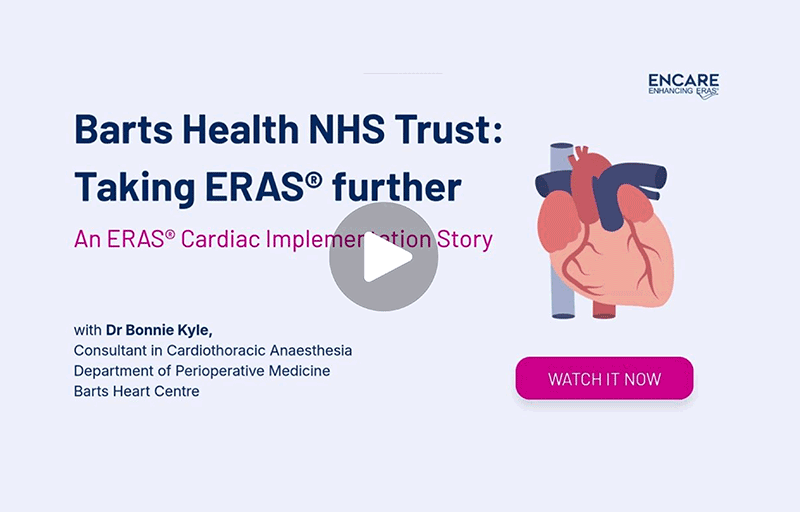
Dr Bonnie Kyle, Consultant in Cardiothoracic Anaesthesia, at Barts Health NHS Trust, has spent three years building one of the UK’s most committed ERAS cardiac surgery programs. Around 1,200 patients. Real clinical results. And a clear-eyed view of what they still could not see.
In this short interview, she talks about what drove that commitment, what a structured audit system changes in practice, and what she would say to other centers doing ERAS their own way.
“To do ERAS® properly, you really need to understand that it is the entire perioperative pathway.”
Barts is now working toward ERAS® Qualification. We are proud to support that journey.
In this six-minute interview, Dr Bonnie Kyle, Consultant in Cardiothoracic Anaesthesia at the Barts Heart Centre, Barts Health NHS Trust in London, explains why the team brought ERAS® into cardiac surgery three years ago and what it has meant for patients and staff. It is aimed at cardiac surgeons, anaesthetists, intensivists, nurses and hospital leaders who are considering or expanding ERAS® in cardiac surgery. You will learn why ERAS® covers the entire perioperative pathway rather than early extubation and mobilisation alone, and how accreditation, audit and benchmarking support continuous improvement.
The team started ERAS® in response to a large post-COVID waiting list, increased patient acuity and long hospital stays, with an initial focus on waiting lists and length of stay. Because they collected a wide range of outcome measures from the start, they could show a reduction in morbidity across several domains for patients on the ERAS® pathways compared with conventional pathways, and they now see ERAS® as proactive prevention of morbidity and complications, with a shared multidisciplinary focus on recovery. The interview covers what accreditation means: confidence for patients that care follows international best practice, less variation between individual clinicians, and recognition for staff. Dr Kyle describes the centre's outcome, process and balancing measures – length of stay, how long indwelling devices such as drains stay in, and morbidity – which have all improved steadily, and explains why real-time audit of compliance with individual ERAS® elements, as with the ERAS® Interactive Audit System (EIAS), and benchmarking against leading international centres fill the remaining gap. The interview closes with the difference between ERAS® and traditional fast tracking, and why complex and higher-risk patients may gain the most from a structured ERAS® approach.
Format: Video interview
Duration: 6 minutes
Language: English (subtitles in English, French, German, Spanish, Portuguese and Swedish)
Speaker
- Dr Bonnie Kyle
Consultant in Cardiothoracic Anaesthesia, Barts Heart Centre, Barts Health NHS Trust, London – leads the enhanced recovery programme in cardiac surgery; describes how it was started, what accreditation means and how audit and benchmarking drive improvement.
Chapters
- 00:00 Introduction
- 00:18 Why Barts started ERAS® in cardiac surgery
- 01:48 What accreditation means for patients and staff
- 03:11 Outcome measures, audit and benchmarking
- 04:37 ERAS® versus fast tracking
Related resources
- ERAS® Interactive Audit System (EIAS) – Encare's audit system for ERAS® compliance and outcomes
- ERAS® Implementation Program (EIP) – Encare's structured programme for introducing ERAS®
- ERAS® Qualification and the map of ERAS® Qualified Centers
- ERAS® Society – guidelines and the ERAS® programme
- ERAS® Cardiac Society – perioperative care in cardiac surgery
- Barts Health NHS Trust
Want to see how EIAS can support ERAS® audit and benchmarking in cardiac surgery? Book a demo