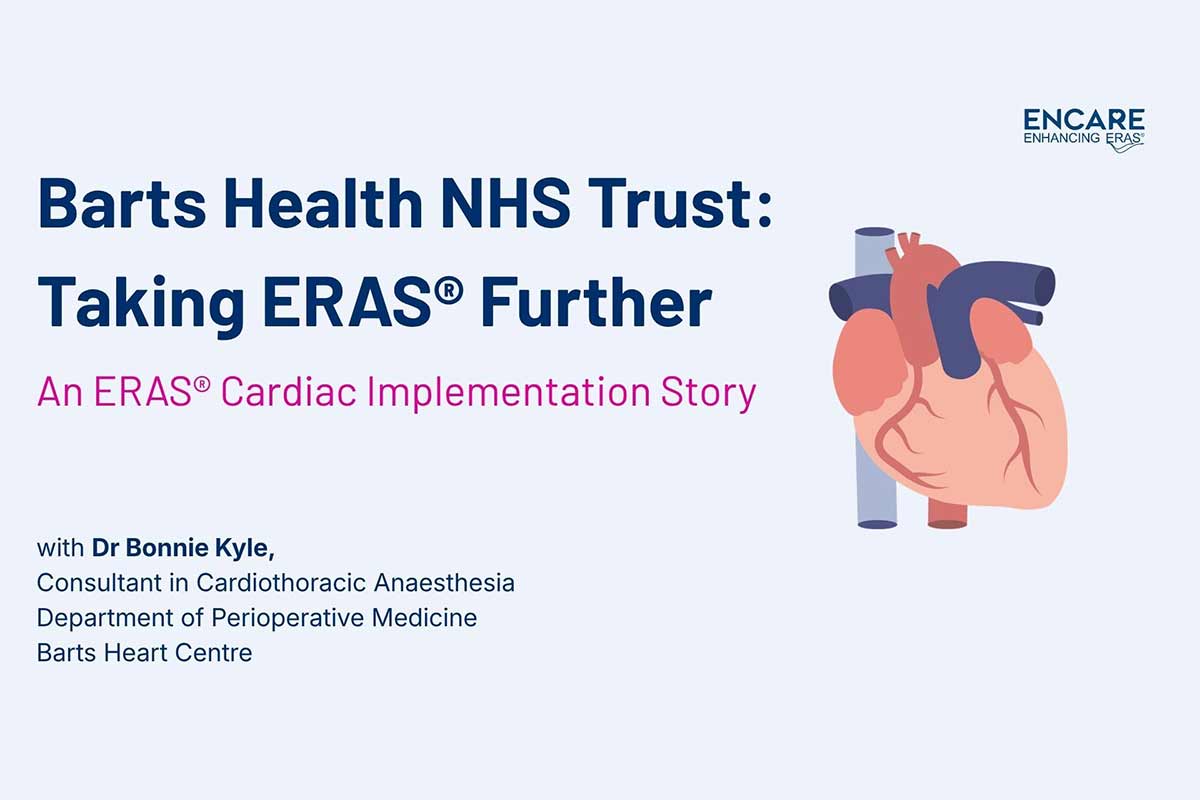
Encare is entering the United Kingdom, and we could not have asked for a better starting point. Barts Health NHS Trust in London is the first hospital in the UK to adopt the ERAS® Interactive Audit System (EIAS) for structured perioperative implementation — and the team behind the decision is exactly the kind of clinical leadership that makes a collaboration worth talking about.
The partnership covers cardiac surgery, with Barts following the EIP Assess pathway: implementing ERAS® protocols independently, supported by structured data entry in EIAS and a dedicated day of expert consultancy. ERAS® Qualification is a defined milestone, with a longer-term ambition to become an ERAS® Center of Excellence.
A program built on three years of commitment
Barts is not starting from scratch. The team, led by Dr Bonnie Kyle, Consultant in Cardiothoracic Anaesthesia, and strong advocate for ERAS® in the UK, has been running an ERAS® cardiac surgery program for three years and has enrolled approximately 1,200 patients. That foundation reflects genuine clinical commitment and a culture that was already oriented toward structured recovery.
What changes now is the ability to measure it. With EIAS, the team gains real-time compliance data, the ability to benchmark with international cardiac surgery centers, and a structured audit framework aligned with the criteria for ERAS® Qualification. Gaps that were previously invisible, such as documentation of early mobilization or 30-day follow-up processes, become visible and addressable.
“ERAS succeeds because the whole multidisciplinary team buys into the ERAS philosophy, and they all work together towards those common goals.” — Dr. Bonnie Kyle
The UK context
ERAS has strong institutional backing in the UK. NHS England has incorporated ERAS® principles into national surgical recovery initiatives, and there is growing clinical momentum around perioperative care as a lever for both patient outcomes and system efficiency. Barts’ decision to pursue ERAS® Qualification, positions the team to lead that conversation nationally and to serve as a reference point for other UK centers considering a more structured approach.
Dr. Bonnie Kyle has also visited leading Cardiac centers applying ERAS in Europe, including programs in Germany, as part of building a vision for where Barts can go. The ambition is not only to improve outcomes at a single site, but to raise the standard of cardiac perioperative care more broadly.
Barts as a reference site
For Encare, this is more than a new customer in a new market. The UK has been on our radar for some time, and Barts Health NHS Trust — one of the largest NHS trusts in England — is the right place to start. The goal is for Barts to grow into a reference site: a living example of what structured ERAS® implementation can look like in a complex, high-volume NHS environment, for other UK hospitals asking themselves the same questions the Barts team was asking a year ago.
Rasmus Waller, CEO of Encare:
“Many hospitals are committed to ERAS® and have built strong programmes locally. But understanding how closely that work follows the evidence — and where improvement is still possible — requires structured measurement. What sets Barts Health apart is the willingness to measure their cardiac ERAS® programme against international guidelines and act on what they find. After three years of clinical commitment, they are now aiming to become the first ERAS® Cardiac Qualified Center in the UK — exactly the kind of partner we wanted as Encare enters the country.“
Dr. Bonnie Kyle, cardiac anesthesiologist at Barts Health NHS Trust:
“We see ERAS as proactive prevention of morbidity complications — proactively making the right decisions and interventions at the right time to keep patients on track and prevent morbidity.“
Every ERAS® implementation journey looks different. Whether your team is just getting started or has been running a program for years, Encare can help you understand where you stand, measure what matters, and take the next step with confidence. Learn more at Solution – Encare.
Watch the interview here: